

Rahu in Dhaniṣṭhā
Some celestial moments announce themselves the way a drumbeat does — loud, insistent, impossible to ignore. From August 2026 through April 2027, Rahu moves through exactly such a moment: Dhaniṣṭhā, the nakshatra of wealth, rhythm, status, and social influence. It's little wonder that this transit is already being billed online as the season when certain zodiac signs will suddenly find themselves rich or famous.
The sky, however, rarely keeps its promises quite so simply.
Dhaniṣṭhā can genuinely open a door to resources, networks, and opportunities that once seemed out of reach. Rahu, forever hungry, magnifies the desire for success until it feels almost unstoppable. But standing behind that promise of abundance is a far sterner presence: Saturn, ruler of both Aquarius and Capricorn, who isn't interested in how much you want — only in whether you're actually equipped to carry what you're asking for.
What deepens this transit further is that, during its first stretch, Saturn is retrograde in Pisces. That creates a rare overlap: grand ambitions arriving at the very moment when unfinished responsibilities, shaky foundations, and old unlearned lessons are demanding attention. The universe seems to be saying: prove you're ready before I hand you what you're asking for.
So the question this transit poses isn't simply how much can you achieve? It's something quieter and more searching: what do you need to build, correct, or release in order to actually be able to carry that success?
Transit Dates for the Netherlands and India
Before going further into what this transit means, it helps to have solid ground under our feet — the exact moments the sky shifts. Astro Wisdom's analysis uses the sidereal Lahiri zodiac, mean Rahu, and the standard calculation method of Jagannatha Hora.
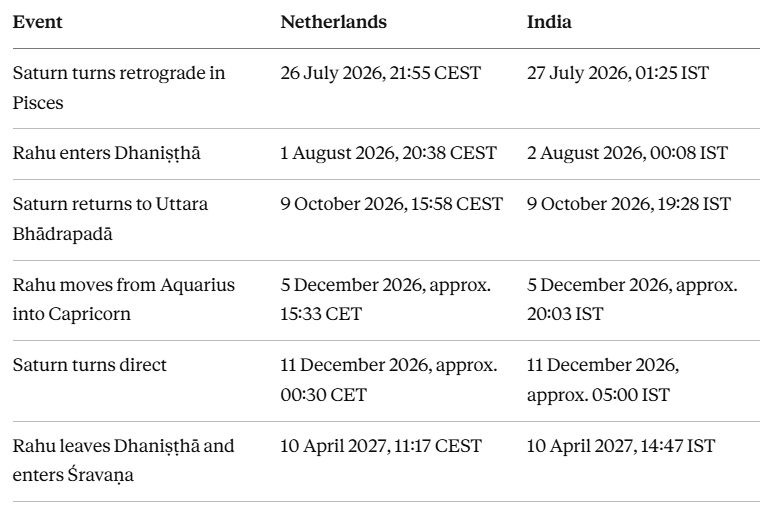
The calendar dates differ between the Netherlands and India simply because India runs several hours ahead — it's the same astrological moment, expressed in two time zones. Astrologers who work with true Rahu will instead place the entry into Dhaniṣṭhā on 30 June 2026 and the exit on 21 April 2027. To avoid mixing systems, this article consistently follows mean Rahu.
What Is Dhaniṣṭhā?
Dhaniṣṭhā is the twenty-third nakshatra, spanning from 23°20′ Capricorn to 6°40′ Aquarius — a bridge between two signs that both fall under Saturn's rule. There's something telling in that placement: right where earth meets air, where structure gives way to vision, sits the nakshatra of wealth.
Its name is often translated as "the wealthiest," "the most prosperous," or "she who holds great resources." The root dhana points to wealth, possession, and value — but anyone who reads this as money alone is only seeing the surface. The wealth Dhaniṣṭhā speaks of is richer and subtler than that. It includes knowledge and skill. It includes access to influential people, a network that holds you up when you need it, reputation and social standing. It includes time, resources, and raw materials. And perhaps rarest of all, it includes the ability to gather people around a shared purpose.
The symbols of this nakshatra are a drum, and sometimes a flute — instruments of rhythm, timing, and resonance. A drum does something money alone cannot: it announces, it calls people together, it makes sure a message carries through an entire community. That's why Dhaniṣṭhā is also linked to music, performance, media, public visibility, and that instinctive feel for the rhythm of a group or a society that some people simply seem to be born with.
The Eight Vasus: Wealth as a Natural Force
Behind Dhaniṣṭhā stand the eight Vasus — deities who embody the fundamental forces and riches of creation itself: earth, fire, wind, space, light, cosmic order. They are not gods of money, but of the very things that make life possible. And in that lies the true nature of Dhaniṣṭhā's abundance: it isn't only about receiving, but about gaining access to what's needed to build something, sustain it, and let it grow.
The Vasus therefore leave us with a question that reaches far deeper than a bank balance: what do you do with the resources entrusted to you? Do you use them purely to grow your own status — or do you also use them to create value for others?
What Does Rahu Do in Dhaniṣṭhā?
Rahu is the planet of insatiable desire. It always fixes our gaze on something new, alluring, exceptional — just out of reach, and irresistible precisely because of it. Wherever Rahu goes, innovation tends to follow, along with international connections, technology, and rapid shifts in society.
In Dhaniṣṭhā, that hunger sharpens considerably. It can produce an extraordinary craving for financial success, for recognition and fame, for powerful networks and a wider audience. For social standing, for access to exclusive circles, for the feeling of growing faster than everyone around you.
This placement can genuinely grant real talent — the ability to spot trends early, to use technology, media, or group dynamics with strategic skill. People touched by this transit sometimes discover new ways of earning, or build a reach through the internet and international contacts that once would have seemed unimaginable.
But Rahu rarely knows a natural limit on its own. And that's where the danger lies: success can curdle into an endless need to prove oneself. Even when everything is going well, a voice keeps whispering that it should be bigger, faster, more impressive still. This shadow side often shows up as an obsession with revenue, followers, or reputation — as confusing status with self-worth, as promising more than one can deliver. It can push people to take risks simply to move ahead faster, to trust the wrong people simply because they seem influential, to build a façade of success with no solid foundation underneath. And almost always, a constant comparison to others creeps in, quietly eating away at the joy of what's already been achieved.
Rahu in Dhaniṣṭhā, then, can show two faces: one opens a door to genuine abundance, the other confronts us with the bottomless pit of never enough.
Mars Shapes How Rahu Acts
Dhaniṣṭhā is ruled by Mars, which makes the position and strength of Mars in the birth chart a key to how this transit will actually unfold for each person. A well-functioning Mars can give Rahu drive, strategic thinking, technical skill, and a healthy entrepreneurial spirit — someone sees an opportunity, and also finds the courage to act on it. A Mars that is under strain or afflicted, on the other hand, can turn that same hunger into impatience and rivalry, into rushed decisions, conflict, and hasty financial moves.
Anyone wanting to truly understand this transit should look beyond simply which house Rahu is passing through. Mars, Saturn, the current daśā, and any birth planets sitting in Dhaniṣṭhā all deserve attention — together, they shape the character of this particular journey.
The Four Phases of Rahu in Dhaniṣṭhā
Rahu, as always, moves backward through the zodiac. That means this transit begins in the fourth pada and ends in the first — a story told in reverse, but no less meaningful for it.
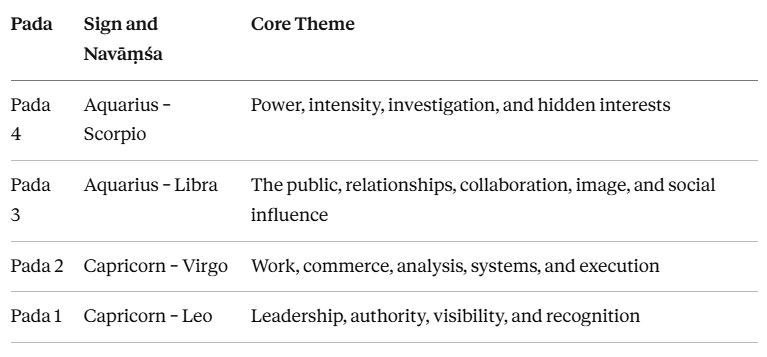
The tone of the transit shifts gradually with each phase, like a piece of music slowly changing key. The opening phase can feel intense, digital, and disruptive to the social order. Later, the emphasis moves toward collaboration and execution, before finally settling into structure and personal leadership.
From Aquarius into Capricorn
Until 5 December 2026, Rahu travels through the Aquarius portion of Dhaniṣṭhā — a sign naturally oriented toward larger groups, societal systems, technology, and collective visions of the future. In this phase, growth can arrive through social media, artificial intelligence and technological innovation, through international communities and large organisations, through social movements and group-based business models.
But from 5 December, Rahu moves retrograde into Capricorn, and the atmosphere shifts noticeably. Attention turns away from reach and future vision, toward structure, hierarchy, and tangible results. An idea that drew a lot of attention while Rahu was in Aquarius now has to prove, in Capricorn, that it's also workable, reliable, and financially sustainable over time.
Why Saturn Is the Key to This Transit
Saturn doesn't literally travel through Dhaniṣṭhā itself — throughout this whole period, it remains in Pisces. And yet Saturn is, perhaps more than any other factor, the one that gives this transit its deeper meaning. Because Saturn rules both Aquarius and Capricorn, which means that for the entire Dhaniṣṭhā transit, Rahu is moving through Saturn's own territory.
There's no direct traditional aspect from Saturn to Rahu during this period. The connection is subtler, and it runs through sign rulership: Saturn is Rahu's dispositor, the quiet landlord of the house Rahu is visiting.
Rahu wants to accelerate; Saturn wants to test. Rahu sees possibility; Saturn asks for proof. Rahu seeks reach; Saturn checks the foundation. When these two forces are held in balance, the result can be remarkably powerful — innovation carried by discipline. But when someone chases only Rahu's quick results while ignoring Saturn, Saturn will sooner or later make itself known, through delays, corrections, and consequences that can no longer be put off.
The Overlap With Saturn Retrograde
From 26 July to 11 December 2026, Saturn is retrograde in Pisces, which means that nearly the entire Aquarius portion of Rahu's Dhaniṣṭhā transit coincides with this retrograde period. Saturn retrograde is a time of revisiting — of obligations, boundaries, structures, and long-term plans that come back up for review. Old responsibilities can resurface, precisely because they weren't fully dealt with the first time around.
Until 9 October, Saturn retrogrades through Revati, a nakshatra ruled by Mercury and centred on completion, guidance, and the passage into a new phase of life. This period can call for finishing old projects, sharpening communication and strategy, settling on the right direction, reducing scattered effort, and reassessing promises and agreements that have been left unresolved for too long.
On 9 October, Saturn returns to Uttara Bhādrapadā, its own nakshatra, and from that point the Saturnian test grows heavier still. Ambitions are now measured against sustainability, responsibility, and integrity — not just potential.
The essence of this overlap can be summed up in a single line: Rahu shows what's possible. Retrograde Saturn shows what needs to be corrected first.
For a fuller discussion, see our earlier analysis: Saturn Retrograde in Pisces 2026: What It Means for Your Career, Money, and Karma.
Predictions for the Twelve Ascendants
The readings below are based on the sidereal ascendant. Rahu moves first through Aquarius and, from 5 December, through Capricorn, while Saturn remains retrograde in Pisces until 11 December.
Aries Ascendant. Rahu first moves through the eleventh house of income, networks, and larger goals. New contacts and digital platforms may bring unexpected opportunities, though it's worth staying wary of anyone who promises a lot of reach but offers little real structure. From December, Rahu shifts into the tenth house of career and reputation, and the pull to perform visibly grows stronger. Saturn in the twelfth house, meanwhile, calls for sensible management of energy and money — growth here shouldn't come at the cost of rest or financial control.
Taurus Ascendant. Rahu first activates the tenth house, which can bring ambition, career change, visibility, and unconventional business openings. Saturn retrograde in the eleventh house asks for a review of income, professional networks, and long-term goals. From December, Rahu moves into the ninth house, where international contacts, publishing, education, and genuine knowledge take on more weight — though it remains wise to check the reliability of teachers, advisors, and beliefs along the way.
Gemini Ascendant. Rahu first moves through the ninth house of higher knowledge, travel, and life philosophy, and a strong pull toward foreign or unconventional knowledge may emerge. Saturn retrograde in the tenth house, meanwhile, calls for corrections in career and responsibility. From December, Rahu enters the eighth house, where other people's finances, taxes, debt, research, and hidden information all demand extra care — avoid taking financial risks without fully understanding the terms.
Cancer Ascendant. Rahu begins in the eighth house, which can bring unexpected developments around shared money, loans, inheritance, intimacy, and psychological patterns. Saturn retrograde in the ninth house prompts a re-examination of beliefs and life direction. From December, Rahu moves through the seventh house, where relationships, clients, and business partnerships intensify — new people may seem influential, but clarity about motives and agreements remains essential.
Leo Ascendant. Rahu first travels through the seventh house, and relationships, clients, and partnerships can grow quickly, though they may also turn confusing or unusually intense. Saturn retrograde in the eighth house calls for financial and emotional boundaries. From December, Rahu moves into the sixth house, which can help with competition, problem-solving, and overcoming obstacles — just be careful to avoid conflict, overload, and obsessive work habits.
Virgo Ascendant. Rahu first activates the sixth house of work, health, competition, and daily obligations. This can bring high productivity, but also restlessness and an uneven rhythm. Saturn retrograde in the seventh house calls for a review of relationships and contracts. From December, Rahu moves into the fifth house, where creativity, entrepreneurship, children, study, and speculative investments draw more focus — avoid financial decisions driven mainly by tension or the need to prove yourself.
Libra Ascendant. Rahu first moves through the fifth house, and creative visibility, content, romance, and entrepreneurship can rise sharply. Saturn retrograde in the sixth house, however, calls for a workable schedule and healthy daily structure. From December, Rahu moves into the fourth house, where home, family, property, and inner peace become more important — a material improvement here won't automatically bring emotional satisfaction with it.
Scorpio Ascendant. Rahu first travels through the fourth house, and a strong urge may arise to change your home, your family standing, or your inner foundation. Property, working from home, and building a professional base of your own may all present opportunities, even as some inner unrest surfaces alongside them. Saturn retrograde in the fifth house calls for a serious review of creative projects, study, children, and legacy. From December, Rahu moves into the third house, where communication, writing, social media, entrepreneurship, and independent initiative all grow stronger — a valuable window for making your knowledge visible, as long as quality stays ahead of speed.
Sagittarius Ascendant. Rahu begins in the third house and can boost courage, commercial skill, communication, and online reach. Saturn retrograde in the fourth house, meanwhile, draws attention to home, family, and emotional stability. From December, Rahu moves through the second house, bringing money, possessions, family, and speech into focus — new income opportunities are plausible, but overreaching and risky financial promises should be avoided.
Capricorn Ascendant. Rahu first moves through the second house of money, possessions, family, and speech, and the desire to grow financially stronger can run high. Saturn retrograde in the third house calls for persistence, careful communication, and realistic execution in business. From December, Rahu reaches the ascendant itself, which can trigger a powerful reinvention of identity, appearance, or personal direction — just make sure the change is rooted in a genuine purpose, not simply the need to impress.
Aquarius Ascendant. Rahu sits first in the first house, which can heighten visibility, ambition, personal magnetism, and the drive to reinvent — while also stirring up uncertainty about one's own identity. Saturn retrograde in the second house calls for control over finances, values, and family responsibilities. From December, Rahu moves into the twelfth house, where international activity, behind-the-scenes work, and spiritual inquiry can become important — watch for hidden expenses, exhaustion, and escapism here.
Pisces Ascendant. Rahu first moves through the twelfth house, and foreign connections, solitude, sleep, hidden processes, and expenses all call for attention. Saturn retrograde crossing the ascendant makes this a deeply personal period of restructuring. From December, Rahu moves into the eleventh house, where networks, income, public life, and long-term goals can grow — and those opportunities land more solidly the more seriously the personal foundation has been reworked during Saturn's retrograde.
Can You Also Read This by Your Moon Sign?
Yes — though the meaning shifts in tone when you do. The ascendant mainly shows which concrete area of life will see developments; the Moon sign shows how you experience the transit emotionally and mentally. So read the section for your ascendant first, and then read that same section again for your Moon sign, as an additional, more psychological layer laid over the first.
A transit might, for instance, point to financial opportunity from the ascendant, while the same period, read from the Moon, reveals that you're living through it with uncertainty or an intense need to prove yourself.
Who Will Feel This Transit Most Strongly?
This transit tends to make itself felt more strongly when your ascendant, Moon, or a significant birth planet sits in Dhaniṣṭhā, when Rahu is moving through an angular house or a major financial house in your chart, when you're running a Rahu, Mars, or Saturn daśā, when Mars or Saturn is strongly connected to Rahu, or when the transit touches a sensitive degree in your birth chart.
Even so, a transit alone never tells the whole story. The birth chart shows what's possible, the daśā determines which karma is active right now, and the transit simply marks the moment when that development can unfold.
How Can You Use This Transit Wisely?
Rahu in Dhaniṣṭhā doesn't need to be feared. It can be a season in which new resources, technology, and influential contacts present themselves — provided you meet them with wisdom rather than hunger alone. Look into opportunities before committing to them. Build your systems before you scale up sharply. Put financial agreements in writing. Choose reliable networks over impressive names. Finish what you've left unresolved instead of pushing it further down the road. Check regularly whether your ambition still lines up with your deeper values, and use visibility mainly as a way to share real value, not simply to be seen.
Dhaniṣṭhā can open the door to greater possibility. Rahu makes sure you notice that door before most of the people around you do. But it's Saturn who ultimately decides whether you have the discipline, integrity, and capacity to actually walk through it.
The true promise of this transit, then, isn't guaranteed or rapid wealth. It's something more lasting: the chance to build a stronger, more honest relationship with ambition, with resources, and with the responsibility that always travels alongside them.
Want to know which house Rahu in Dhaniṣṭhā occupies in your own birth chart? A personal Vedic reading combines your ascendant, Moon sign, birth planets, and current daśā to explore which themes are genuinely activated for you.
Astro Wisdom Online Ancient Wisdom. Modern Insight.
Reactie plaatsen
Reacties