

"If my chart shows so much potential, why hasn't it happened yet?"
There is a question that surfaces again and again through the centuries, whispered in the conversations of seekers, in the silence after a chart reading, in the heart of everyone who has ever looked up at the stars in search of answers. It may well be the most frequently asked question within astrology, and yet each time it arises, it remains just as disarmingly honest.
People discover talents in their birth chart that they had never quite named before. They read about indications of success, of wealth, of love, of entrepreneurship, of spiritual growth — and feel a recognition that almost feels physical, like a key sliding perfectly into a lock they always carried but never dared to open. And then, inevitably, comes the question that falls like a stone into still water: if all of this is written in my chart, why hasn't it become reality yet?
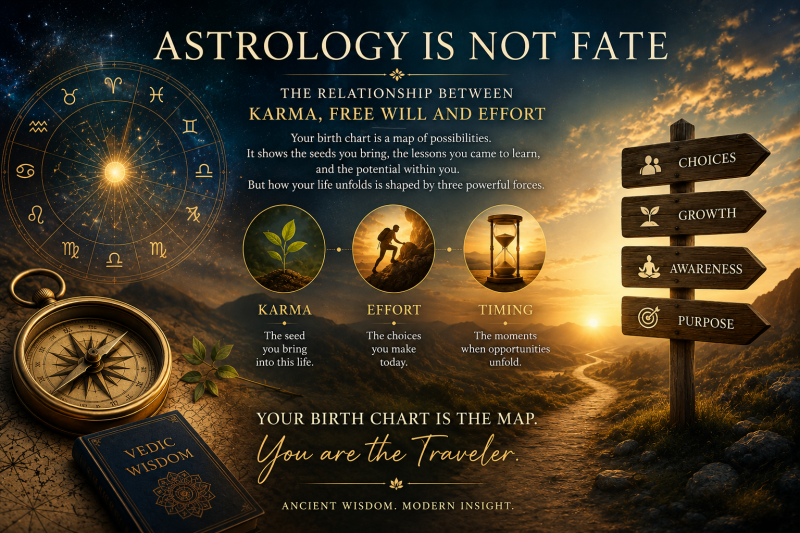
The answer to that question doesn't lie on the surface. It is hidden within one of the most fundamental principles of Vedic astrology, a truth so simple that it is easily overlooked: a chart shows possibilities, not guarantees. Astrology describes the playing field of your life, the contours of the land on which your story will unfold. But how that field actually takes shape, how the lines form and the goals are reached, depends on something deeper than the planets alone: karma, choices, effort, and timing.
Is Your Life Predetermined?
One of the most widespread misunderstandings about astrology is the idea that everything is fixed, that life is a script already written in which a person merely recites their lines. But anyone who reads the classical Vedic scriptures carefully discovers that this picture doesn't hold up. If everything truly and unchangeably lay fixed, why would the sages of old place so much weight on dharma, on consciousness, on self-development, on discipline and spiritual growth? A world of pure predestination would render such efforts pointless.
The ancient rishis looked at existence differently. They did not see life as a prison of fate, with bars made of stars and planets from which there is no escape. They saw life as a collaboration — a subtle and ongoing interplay between karma, free will, and divine timing. Three forces that continually touch, influence, and balance one another, like three rivers merging into a single stream.
The Chart Is a Blueprint
Picture a birth chart as a map handed to you at the moment of your birth. This map shows where your natural talents lie, which challenges will appear on your path, which life lessons call for attention, which areas of life are strongly activated, and which experiences are likely to repeat themselves until they are truly understood.
But a blueprint is not yet a house. An architect can draw the most refined and thoughtful design, with every room carefully considered and every window placed just so to let the light in at the right time of day — and still, no one will be able to live in that house until someone actually lays the bricks. In exactly the same way, your chart shows what is possible. The walls, the foundation, the design of your life already lie ready. But you are the one who must build it.
The Three Forces That Shape Your Life
Within the Vedic tradition, this interplay is explained through three forces that are constantly in conversation with one another.
1. Prarabdha Karma
Prarabdha Karma is the part of your karma that has already ripened, like fruit ready to fall, and that seeks to express itself in this life. Your birthplace, your parents, your body, certain innate talents, significant encounters that turn the course of your life, and recurring life themes that keep returning like a melody — all of this falls under Prarabdha. These are matters largely beyond your direct control, not because the universe is random, but because they are the fruit of actions sown earlier. They form the starting point of your life, the backdrop against which the first act of your story plays out. The birth chart is, in essence, a reflection of this ripened karma.
2. Purushartha
Purushartha means conscious effort — and here, precisely here, your free will steps onto the stage. You can develop a talent that existed only in seed form. You can start a business based on an idea that had quietly simmered within you for years. You can deepen a relationship, learn new skills, make healthier choices in your daily life.
Two people can carry exactly the same potential, born under nearly identical celestial conditions, and yet one will flourish while the other leaves that same potential untouched, like an instrument that is never played. Why this difference? Because of Purushartha. Because of the effort one person makes and the other does not.
3. Kala
Kala means time, or more precisely: timing — the season in which something is able to come into bloom. Some events are possible, but not yet ripe to occur. An apple tree bears no fruit in winter, and this has nothing to do with any flaw in the tree itself. It is simply not yet the right season.
This is why astrologers turn their attention to the dashas, the transits, the planetary periods that move through a life like seasons. Timing determines when certain possibilities become more readily accessible, when a door that always existed suddenly opens more easily.
The Most Beautiful Example: A Seed
Let me offer you an image that brings all of this together. Imagine holding an acorn in your hand, small and unassuming, almost insignificant. And yet this acorn carries within it the full potential to grow into an enormous, centuries-old oak. But three things are needed for that to happen.
First, the potential itself: the genetic blueprint already contained within the seed, comparable to your birth chart, which carries your innate possibilities within it long before a single root has touched the soil.
Then, the effort: the seed must be planted, watered, protected against frost and neglect. This is Purushartha, the action that gives potential a chance to breathe.
And finally, time: the tree does not grow in a single day, no matter how much love and water you give it. This is Kala, the patience that life itself asks of us.
Only when these three forces work together — potential, effort, and time — does the tree come into being. Not before, and not through any one of the three alone.
Why Two People With the Same Chart Differ
Here we find one of the most beautiful and most convincing proofs that astrology is not a purely fatalistic system. There are twins who share nearly identical birth charts, born within minutes of each other, under exactly the same sky. And yet they often lead entirely different lives, with different choices, different relationships, different destinies.
How can this be? Because the chart only describes the potential — the score, not the performance. The way someone actually uses that potential differs from person to person. Choices differ. Circumstances differ. Effort differs. And perhaps most importantly of all: consciousness differs. One twin may awaken to their own possibilities, while the other remains asleep within the very same cosmic design.
The Real Meaning of House Activation
Within modern astrology you often hear the phrase: "you need to activate a house." But what does this actually mean, once we look past the surface-level language?
Activating a house does not mean flipping some magical switch somewhere, as if the universe operated on a remote control. It means consciously and actively participating in the areas of life that house represents — getting your hands into the very terrain the stars have pointed you toward.
Take the seventh house, for example. This house relates, among other things, to clients, relationships, partnerships, trade, contracts, and public life. You don't activate this house by merely reading about it or meditating on it, but by actually helping clients, building a network, entering into partnerships, starting a business, consciously and caringly shaping your relationships. The activation lies in the action, not in the knowledge alone.
So What Does a Strong Rahu Actually Mean?
Many people hold on to the idea that "Rahu brings wealth" — a simplistic reading that does no justice to the true nature of this shadow planet. Rahu, in itself, does not grant wealth. Rahu grants desire. Ambition. A deep, sometimes restless hunger. Growth that refuses to be held back, and the willingness to look beyond the horizon that others treat as a boundary.
This energy can lead to entrepreneurship, to innovation, to great successes and international opportunities that lie far beyond the familiar. But that same energy, when lived unconsciously, can just as easily lead to restlessness, excess, lasting dissatisfaction, and risky behavior. Rahu amplifies — that is his true nature. But what exactly he amplifies depends on the rest of the chart and, once again, on the choices you yourself make within that amplifying field.
Why Astrology Can Be So Powerful
The real power of astrology does not lie in predicting the future, much as people may long for that. The real power lies in self-knowledge — in the quiet, patient light a chart can cast upon your own soul.
When you understand where your talents truly lie, where your pitfalls wait in ambush, which lessons keep returning in different forms, and which energies are active in your life at this moment, room opens up for more conscious choices. Astrology does not change your karma — that is not its function. But it can change how you relate to that karma. And that shift in consciousness, however subtle, often changes your entire life.
The Wisdom of the Bhagavad Gita
In the Bhagavad Gita, Krishna offers one of the most memorable teachings ever spoken about karma, a truth that has guided generations of seekers: you have a right to your actions, but not to the fruits of those actions.
Within these words lies a profound spiritual secret. Your task in this life is not to control the outcomes — that has never truly been within your power. Your task is to offer the right effort, with purity and devotion, and to let the outcome rest afterward in trust. Results, after all, do not arise from effort alone, but from a convergence of karma, effort, timing, and grace — four rivers that together form the current of your life.
Conclusion
Your birth chart is not a prison in which you are confined for life. It is a map. A blueprint. A compass that offers direction without making the journey for you. It shows which possibilities are present within you, like seeds waiting for the right season. But possibilities, as we have seen, are not guarantees.
In the end, life arises from the collaboration between three forces that continually hold one another in balance: Prarabdha Karma, the karma you are born with; Purushartha, your own effort; and Kala, the divine timing that allows everything to ripen in its own moment. When these three elements come together, potential slowly but surely begins to become reality.
Not because the stars fully determine your life, as if pulled by strings from above. But because they help you understand which seeds are present within your soul, which possibilities already lie dormant, waiting for you. And what you do with those seeds afterward — how you water them, protect them, and let them grow — that, precisely there, is where your free will begins.
Astro Wisdom
Ancient Wisdom. Modern Insight.
Discover the unique blueprint of your life with a personal Vedic chart reading, and learn how karma, talent, timing, and free will come together to shape your life's path.
Reactie plaatsen
Reacties