

Why do some years seem to bring movement almost effortlessly, while other periods revolve around responsibility, relationships, inner transformation or the need to reconsider your direction?
A birth chart describes more than your natural qualities and recurring life patterns. Vedic astrology also uses techniques to examine when particular parts of the birth chart are more strongly activated. One of the most widely used timing systems is Vimshottari Dasha.
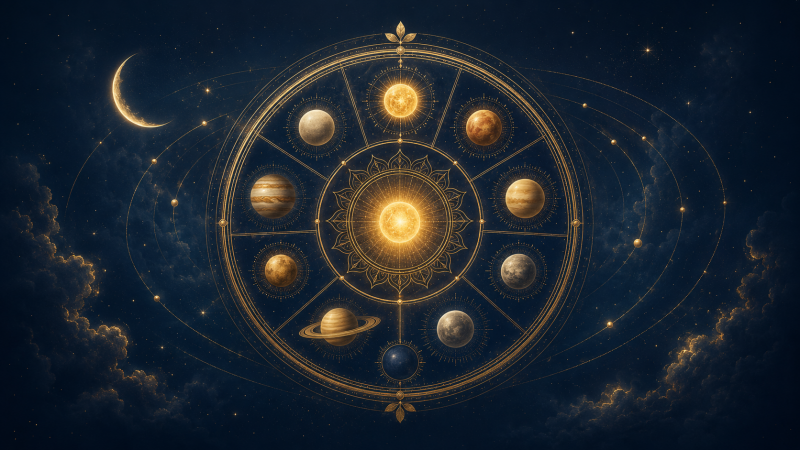
Vimshottari Dasha divides life into a sequence of planetary periods. Each period is associated with one of the nine grahas: Ketu, Venus, the Sun, the Moon, Mars, Rahu, Jupiter, Saturn and Mercury. This does not mean that one planet independently controls your destiny for a number of years. Its results must always be understood through the complete birth chart.
In this guide, you will learn how the Vimshottari Dasha cycle is structured, what Mahadasha and Antardasha mean, and why the same planetary period can manifest very differently for two people.
What does Vimshottari Dasha mean?
The word Vimshottari refers to a cycle of 120 years. In this context, Dasha means a condition, phase or planetary period. The complete Vimshottari cycle distributes these 120 years among nine planetary rulers.
The classical Jyotish tradition contains several dasha systems. Vimshottari Dasha is the best known and most frequently used. One of its defining features is that its starting point is not determined solely by the ascendant or Sun sign. It begins from the precise position of the Moon within a nakshatra at birth.
A dasha can be understood as an astrological timing indicator. The birth chart reveals the patterns, possibilities and tensions that are present; the dasha helps an astrologer examine which of them may become more prominent during a particular phase of life.
The nine Mahadashas and their duration
The nine major planetary periods follow a fixed sequence:
Ketu 7 years
Venus 20 years
Sun 6 years
Moon 10 years
Mars 7 years
Rahu 18 years
Jupiter 16 years
Saturn 19 years
Mercury 17 years
Total 120 years
The sequence always remains the same. However, not everyone begins life in Ketu Mahadasha, and very few people are born on the first day of a complete planetary period. The personal starting point is determined by the Moon’s birth nakshatra and its exact position within that nakshatra.
How is your first Mahadasha determined?
Vedic astrology divides the sidereal zodiac into 27 nakshatras, often translated as lunar mansions. Each nakshatra is ruled by one of the nine grahas. The sequence of nine rulers repeats three times across the 27 nakshatras.
If the Moon occupies a Moon-ruled nakshatra at birth, the person is born during Moon Mahadasha. If it occupies a Jupiter-ruled nakshatra, the person begins life within Jupiter Mahadasha.
The calculation does not end there. An astrologer also determines how much of the nakshatra the Moon has already travelled through at the moment of birth. This establishes the remaining balance of the first Mahadasha. A person may therefore be born near the beginning, middle or end of a major planetary period.
This is why two people with the same Moon sign can still have different dasha timelines. The nakshatra and the Moon’s precise degree make the timing more personal.
What is the difference between Mahadasha, Antardasha and Pratyantardasha?
A Mahadasha lasts several years and forms the broad background of a life phase. Each Mahadasha contains shorter sub-periods called Antardashas. Every Antardasha can be divided into even smaller periods, including the Pratyantardasha.
You can compare these levels to the structure of a book:
Mahadasha: the major chapter of life;
Antardasha: an important subject within that chapter;
Pratyantardasha: a shorter development within that subject.
During Jupiter Mahadasha, for example, a person moves through the Antardashas of Jupiter, Saturn, Mercury, Ketu, Venus, the Sun, the Moon, Mars and Rahu. The sixteen years of Jupiter Mahadasha will therefore not all feel the same.
The combination of the major period and sub-period is essential. Jupiter–Saturn may connect different houses and themes from Jupiter–Venus. Shorter sub-periods and transits can be used for more detailed timing, but greater detail does not automatically create greater certainty. The underlying chart interpretation must be sound first.
Why does the same Mahadasha produce different results for different people?
Online descriptions often reduce a Mahadasha to the general nature of its ruling planet. Jupiter is said to bring expansion and prosperity, Venus love and luxury, and Saturn delays and difficult lessons. These descriptions may sound familiar, but they are astrologically incomplete.
Every planet has a specific function in an individual birth chart. To assess how a Mahadasha may operate, a Vedic astrologer examines factors such as:
the houses ruled by the dasha planet;
the house and sign it occupies;
its dignity, strength and condition;
conjunctions and aspects;
relevant divisional charts or vargas;
the active Antardasha;
current transits;
and, most importantly, the promises already contained in the natal chart.
A naturally benefic planet does not necessarily deliver only easy results in every chart. Conversely, a period ruled by Saturn, Mars, Rahu or Ketu does not have to be exclusively negative. A planet may bring responsibility or confrontation while simultaneously activating mastery, independence, long-term growth or a significant change of direction.
There is therefore no Mahadasha that is universally the best or the worst.
What can Vimshottari Dasha reveal?
Vimshottari Dasha is used to examine when certain areas of life may become more prominent. Depending on the personal birth chart, these may include:
career, leadership or entrepreneurship;
income, wealth and financial responsibility;
relationships, marriage and family;
education, knowledge and spiritual development;
relocation or living abroad;
health and recovery;
loss, release and inner transformation.
A dasha does not simply create an event that has no support in the chart. It activates planets, houses and relationships that are already part of the natal pattern. Careful prediction must therefore begin with the birth chart itself, not with an isolated dasha table.
Dasha versus transit: what is the difference?
Dashas and transits are often confused because both are used for timing. However, they approach timing from different perspectives.
A dasha is a personal cycle calculated from the Moon’s position at birth. A transit describes the current movement of a planet through the zodiac and in relation to the natal chart.
In simple terms:
the birth chart reveals the underlying structure and potential;
the dasha indicates which planetary themes are personally activated;
transits may support, delay or trigger developments within that active period.
Jupiter’s transit through a sign is the same astronomical movement for everyone, but it does not produce identical results. The houses Jupiter moves through, the natal chart and the active dasha vary from person to person. This is one reason why general forecasts cannot offer the same degree of individual detail as a personal analysis.
Can you calculate your Vimshottari Dasha online?
An online Vimshottari Dasha calculator can usually show:
the Mahadasha active at your birth;
your current Mahadasha;
your current Antardasha;
the beginning and end dates of each period.
An accurate calculation requires your date, time and place of birth. It is also useful to check which astrological system and ayanamsha the calculator uses, as different settings may produce small variations in timing.
A calculator primarily provides the timeline. Seeing “Jupiter Mahadasha” does not tell you whether Jupiter will principally activate career, wealth, education, children, relationships, health or spiritual development in your chart. That requires an examination of Jupiter’s placement, house rulership, strength and connections in your individual horoscope.
Calculating a dasha and interpreting it are two different steps.
How important is an accurate birth time?
The position of the Moon determines the starting point of Vimshottari Dasha. Because the Moon continues to move during the day, an inaccurate birth time can affect the remaining balance of the first Mahadasha and, consequently, the later beginning and end dates.
If the Moon is close to the boundary between two nakshatras, greater uncertainty about the birth time may even change the starting Mahadasha. Birth time becomes still more important when divisional charts and more precise event timing are used, because the ascendant and divisional placements can change more quickly.
When the recorded birth time is uncertain, an astrological analysis should acknowledge that uncertainty. Apparent precision is not the same as reliability.
Is a difficult Dasha a form of punishment?
An intense dasha is sometimes described as bad karma or punishment. This is too simplistic. Certain periods can undeniably be demanding, but their meaning may extend beyond loss or hardship. They can reveal necessary boundaries, require greater responsibility, bring old patterns to an end or redirect someone towards a more appropriate path.
Astrology does not remove every form of personal choice. The birth chart and dasha describe an astrological pattern and the quality of a period. How a person responds, which support they seek and which decisions they make continue to matter.
Vedic astrology is therefore most valuable when it offers insight and preparation—not when it creates fear or dependency.
Vimshottari Dasha as your personal planetary timeline
Vimshottari Dasha brings the birth chart into motion. The natal chart shows what is present; the dasha helps us understand when particular parts of it may come forward more strongly.
The name of your current Mahadasha is only the beginning. A reliable interpretation requires the combined study of the dasha ruler, its placement and house rulership, the active sub-period, relevant vargas and current transits.
Vimshottari Dasha then becomes more than a generic description of a planet. It becomes a personal timeline that helps explain why different chapters of life carry their own themes, challenges and possibilities.
Frequently asked questions about Vimshottari Dasha
Which Mahadasha am I currently in?
This is calculated from your date, exact time and place of birth, together with the Moon’s position in its birth nakshatra. A calculator can show the timeline; the full birth chart is needed to understand its personal meaning.
Which Mahadasha is the best?
No Mahadasha is the best for everyone. Its results depend on the role, placement, strength and connections of the relevant planet in the individual birth chart.
Is Saturn Mahadasha always difficult?
No. Saturn may emphasise delay, discipline and responsibility, but it can also activate lasting achievement, expertise, leadership and stability. The personal chart determines which themes become most prominent.
What is the difference between Mahadasha and Antardasha?
Mahadasha is the longer major planetary period. Antardasha is a shorter sub-period within it and refines which planets and areas of life are active during that part of the main period.
Can Vimshottari Dasha predict marriage or career events?
The system can help identify periods when relationship or career themes are more strongly activated. A dasha by itself does not guarantee marriage, promotion or another specific event. The complete birth chart, relevant houses, divisional charts and transits must support the theme.
Can a dasha calculator predict my future?
A calculator mainly determines the beginning and end dates of planetary periods. It does not automatically understand the complete role of each planet in your birth chart and therefore cannot replace a careful personal interpretation.
Personal Vedic astrology analysis
Would you like to know which Mahadasha and Antardasha are currently active and what this combination means within your birth chart? A personal Vedic astrology analysis goes beyond the name of the planet to examine which houses, patterns and areas of life are actually being activated.
Reactie plaatsen
Reacties